Full
Collection
Authenticated works by Hungarian and international masters. Every piece accompanied by a certificate of authenticity and expert documentation.
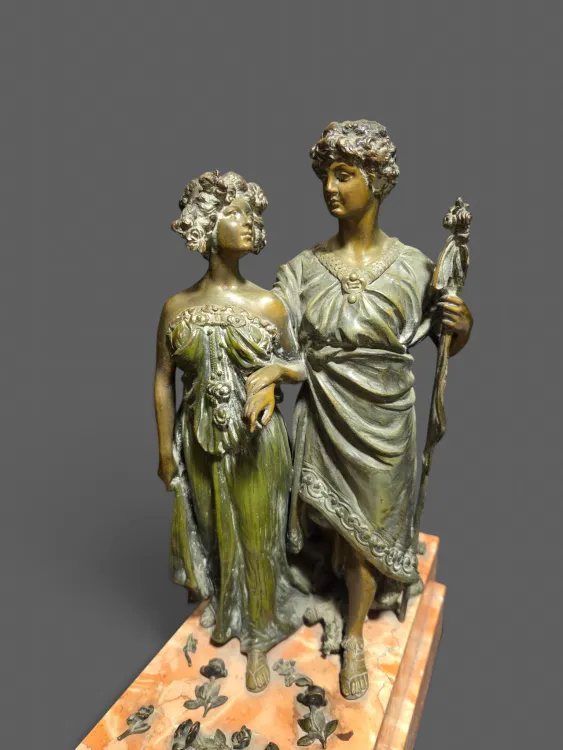
Date of creation: around 1900 (turn of the 19th and 20th centuries)Style: Neoclassicism / Historicism with Art Nouveau influencesTechnique / Material: Polychrome patinated metal alloy (hollow cast), with period two-pin copper screw fastenings, on a stepped red breccia marble plinthDimensions: Height: 30 cmMarkings: UnmarkedGenuine, original composition dating from around 1900 (turn of the century):The two-pole / slotted copper nuts (so-called écrou à encoches/ slotted round nuts) in the recessed holes on the marble base represent the textbook fastening technique used by Parisian and Viennese foundries (e.g. Fonderia / Société des Bronzes de Paris, Viennese salon sculpture workshops) in the late 19th and early 20th centuries. Modern replicas use metric hex-head nuts or adhesive, but here both figures and the stepped marble are held in place by original, hand-tightened, period nuts with notches on both sides.The stone itself is genuine, solid Italian/French red-salmon breccia marble (not synthetic resin or cement cast), and the signs of wear and scratches on the base are natural, bearing witness to more than 100 years of use.100% verification of the material:The grated/worn metal surface visible at the end of the threaded shank and on the rim of the nut unequivocally confirms the initial diagnosis: the body of the statue itself is a polychrome patinated zinc alloy (spiater / régule) (whilst the threaded pins are cast from brass and fixed into it, in accordance with the classic French régule d’art technique).1. The male figure: the Belvedere Antinous (in fact, the Belvedere Hermes / Antinous type) and pastoral/Dionysian attributesThe ancient prototype: the Belvedere Antinous (one of the most famous Roman marble sculptures in the Vatican Museums, a heroic-melancholic depiction of Antinous, Emperor Hadrian’s favourite, which was copied and adapted countless times during the Renaissance and Neoclassical periods). The statue’s head posture, short, curly locks, delicate, slightly downward-cast facial features, and the drape of the strongly evoke the iconographic type of the Belvedere Antinous (and the Belvedere Hermes, with whom he is often associated).Additional note: The staff held in the statue’s left hand, decorated with ribbons and flowers/garlands, is a thyrsus / shepherd’s crook motif, which reinforces the bucolic-Dionysian atmosphere, whilst the sandal visible on his foot and the shortened, ornately hemmed ancient robe evoke the Roman/Hellenistic world.2. The female figure: a fusion of the Roman Pudicitia and the Capitoline / Medici Venus typesThe ancient prototype: One of the best-known female types in Roman sculpture is Pudicitia (the personification of modesty/dignity) and the draped Hellenistic nymph/muse types (such as the women of Herculaneum or the ancient figures with richly draped cloaks gathered at the back or flowing down).The Art Nouveau adaptation: Whilst the ancient Pudicitia closely covers the body, here the artist has combined her with an Art Nouveau–Neoclassical twist: on the upper body, a peplos-like design appears, adorned with delicate garlands and pearl-string motifs whilst revealing the chest and shoulders, whilst the posture of the figure, the antique hairstyle arranged in a bun or curls, and the dress, which falls in a long, train-like drape onto the red marble plinth, evoke the elegance of classical Roman draped sculptures.3. The roses scattered across the plinth and the Cupid and Psyche / Amor and Venus themeThe way the two figures face one another, their clasped or touching hands, and the roses scattered across the red marble plinth convey the lyrical atmosphere of the Roman Venus–Mars / Venus–Adonis / Cupid and Psyche, into the bourgeois salon sculpture of the turn of the 19th and 20th centuries (c. 1890–1910).
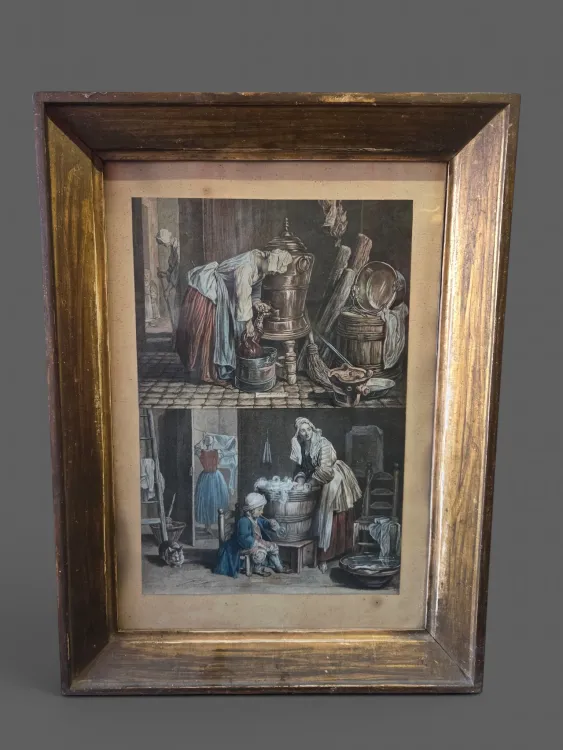
Artist / Engraver: Charles-Nicolas Cochin (1715–1790), engraved after paintings by Jean-Baptiste-Siméon Chardin (1699–1779)Title: *La Fontaine* (The Water-Carrier) and *La Blanchisseuse* (The Washerwoman) – A pair of Rococo genre scenesDate: Late 18th century – early 19th century (based on Cochin’s engravings from 1739)Style: French Rococo genre artTechnique / Material: Hand-coloured copperplate engraving and etching on paper, in an original, contemporary Biedermeier gilded and bronzed frame with a pine backing boardMarkings: Engraved mark in the cartouche beneath the upper scene: ‘gravé par C. N. Cochin’Description and art-historical analysisEvoking the finest traditions of 18th-century French bourgeois genre painting, this finely executed, hand-coloured pair of copperplate engravings, which presents Jean-Baptiste-Siméon Chardin’s most famous scenes of everyday life in two compositions arranged one below the other.The upper scene (La Fontaine) depicts an intimate kitchen interior: a maid, leaning over the tap of a copper water jug, pours water into a jug, whilst in the background, through an open door, the figures of an elderly woman and a small child appear; in the foreground, copper vessels, a broom and a pot on the hob create a still-life-like richness. The lower composition (La Blanchisseuse) captures the quiet labour of the washerwoman: the mother, standing beside the wash tub, watches her little boy sitting on a small stool with a tender gaze as he blows soap bubbles with a straw, whilst in the adjoining room a woman is hanging out washing, whilst to the left a curled-up cat rests.The masterful network of lines in the engravings is complemented by contemporary, hand-coloured watercolours in subdued tones – the reddish-brown skirts, the blue jacket, the warm glow of the copper vessels and the deep shadows of the interiors form an exceptionally harmonious whole. The print is preserved in its original, early 19th-century, bevelled-profile, patinated gold-bronze frame and a contemporary pine backing board.Dimensions including frame: 63 x 46 cm.
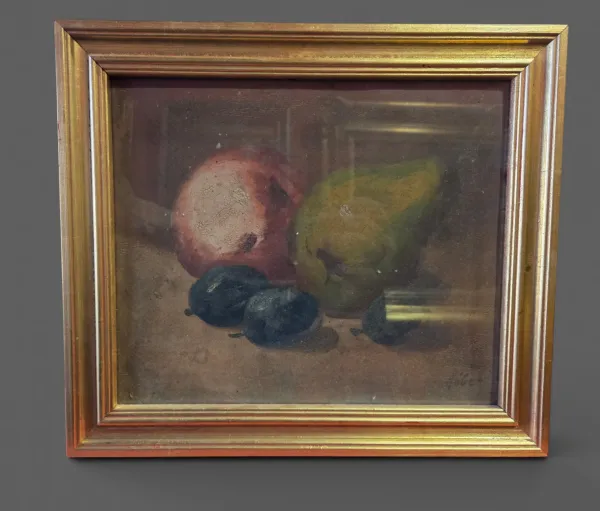
Date of creation: first half of the 20th century (1920s–1930s)Style: Classical realism / bourgeois still life paintingTechnique / Material: Oil on cardboard, in a period gilded and bronzed wooden frame, behind glassDimensions: 26 × 20 cm (including frame)Support: oil on cardboardSignature: Signed lower right (Hober / Kóber)A small, classic fruit still life with an intimate atmosphere from the first half of the 20th century. The artist has depicted a group of everyday fruits arranged on a simple tabletop: on the left-hand side of the composition is a reddish apple (or peach) with a downy skin, next to it a ripe, yellow-green pear, and in the foreground three dark blue, downy plums.Dimensions including frame: 26 x 32 cm.
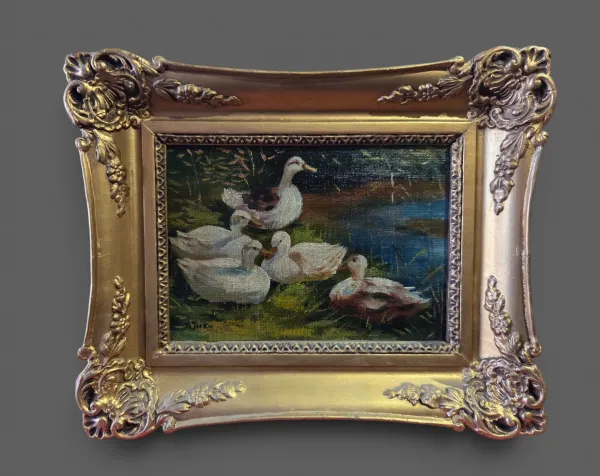
Title: Ducks by the Lake (A Scene from Country Life)Date: First half of the 20th century (circa 1930)Style: Naturalistic animal depiction / bourgeois genre paintingTechnique / Material: Oil on canvas, mounted on a stretcher, in a neo-Baroque decorative frame with curved sidesDimensions: 13 × 18.5 cm (without frame)Signature: Signed lower left (V. Terku / J. Terku)Technique, stretcher and frame: On the reverse is an authentic, small stretcher dating from the first half of the 20th century, with original, coarsely woven linen canvas, as well as an exceptionally striking, neo-Baroque/Rococo-style gilded decorative frame with curved sides, featuring shell and floral motifs. A charming, intimate small cabinet painting from the first half of the 20th century, depicting a group of five ducks resting and swimming on a reed- and grass-lined riverside. On the left-hand side of the composition, ducks with white and variegated plumage can be seen huddled together in the lush green grass, whilst on the right-hand side, the deep blue water and the darker, mysterious tones of the riverside reeds create a sense of natural depth.The painting is executed in a warm, harmonious colour scheme with a bold, more impasto brushstroke: the bright white and ochre-brown patches of plumage stand out vividly against the moss-green shades of the grass and the deep blue hues of the water. A special feature of this small-scale work is the richly carved and patterned, gilded neo-Baroque decorative frame with curved lines, which is fitted to it; at its corners, it features shell and floral motifs, whilst its inner rim is adorned with rows of pearls and leaves, emphasising the jewellery-like quality of the cabinet paintingArt-historical backgroundBetween the end of the 19th century and the first half of the 20th century, small-scale (so-called ‘cabinet-sized’) animal and genre paintings were popular wall decorations in bourgeois salons. Domestic animals – particularly poultry and waterfowl – evoked the tranquillity and closeness to nature of rural life; in keeping with the tastes of the era, these were displayed in interiors within ornate, neo-Baroque gold frames.Dimensions including frame: 20 x 25.5 cm.
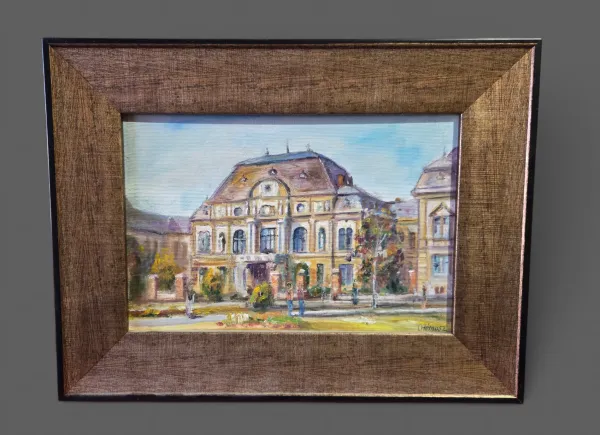
Artist: József Orémusz (born 1965)Title: Cityscape of Nyíregyháza (Kossuth Square and the Town Hall)Date: Contemporary (2010s–2020s)Style: Contemporary Post-Impressionist / plein air cityscapeTechnique / Medium: Oil on canvas (mounted on board / blind-mounted), in a modern, brushed bronze-gold-toned wooden frameDimensions: 20 × 30 cm (without frame)Signature: Bottom right: OrémuszSubject: The iconic view of Kossuth Square in Nyíregyháza, centred on Nyíregyháza Town Hall (formerly the Savings Bank/Administrative Palace) with its mansard-roofed, neo-Baroque-eclectic façade. As the Laczják Art Gallery is also based in Nyíregyháza, from a local historical and patriotic perspective, this is a particularly rewarding and beautiful work!A contemporary cityscape, rich in light and atmosphere and painted in the plein air style, which captures the façade of one of the most distinctive buildings on Nyíregyháza’s historic main square, Kossuth Square: the mansard-roofed, eclectic-Neo-Baroque Town Hall. At the centre of the composition stands the palace with its ochre-and-golden-yellow walls and arched pediment, framed on the left by the western wing of the square and on the right by a detail of the neighbouring corner building.József Orémusz captured the atmosphere of the town square with a light, dynamic brushstroke and a warm, sun-drenched colour palette. The warm yellows of the façades and the lilac-brown tones of the roof are in delicate harmony with the cheerful, light blue sky, whilst the tiny figures strolling in the foreground and the colourful foliage of the trees standing before the building lend a lively, pulsating rhythm to the scene. The painting is framed by a tasteful, modern, dark-edged, brushed antique gold-bronze frame. This work is particularly appealing to collectors with a local pride, those interested in Nyíregyháza interiors, and lovers of cityscapes.Dimensions including frame: 30 x 40 cm.
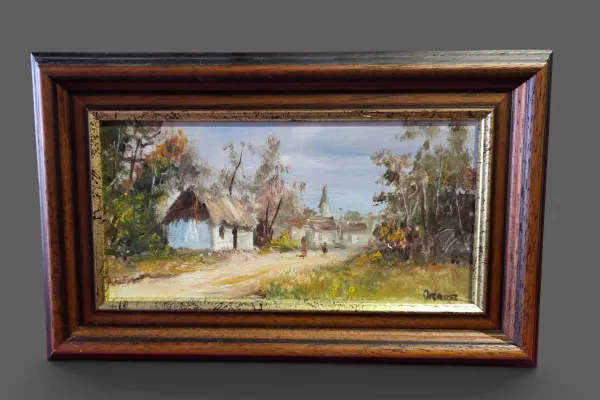
This painting depicts another of the artist’s favourite worlds, capturing a village street scene from the Nyírség and Carpathian regions (featuring a thatched, whitewashed farmhouse reminiscent of the atmosphere of the Sóstó Museum Village, with a church tower rising in the distance).Artist: József Orémusz (born 1965)Title: Village street scene with a white farmhouse (Nyírség / Carpathian landscape)Date: Contemporary (2010s–2020s)Style: Contemporary Post-Impressionist / plein air landscape and genre paintingTechnique / Medium: Oil on fibreboard / canvas, in a dark brown wooden frame with an antique-finished gold inlayDimensions: 10 × 20 cm (without frame)Signature: Bottom right: OrémuszDimensions with frame: 16 × 26 cm.An intimate, cabinet-sized contemporary plein air landscape evoking the peaceful atmosphere of traditional Hungarian and Transcarpathian village life. On the left-hand side of the composition, sheltered by trees with lush foliage tinged with autumnal hues, stands a classic thatched farmhouse with whitewashed walls, beside which a winding, sandy track leads towards the heart of the village. In the distance, the outlines of further village houses and the silhouette of a slender church tower rise against a veiled, pale blue sky, whilst tiny figures walking along the road lend a human scale and a sense of living rhythm to the scene.József Orémusz worked with light, impasto brushstrokes and a palette based on warm, earthy colours: the ochre-coloured road, the cooler shadow cast by the white house wall, and the rust-brown and olive-green tones of the foliage create a harmonious, nostalgic atmosphere. The small painting is framed by a dark brown wood frame with a tasteful, antiqued gold inner border, which brings the whole composition together.
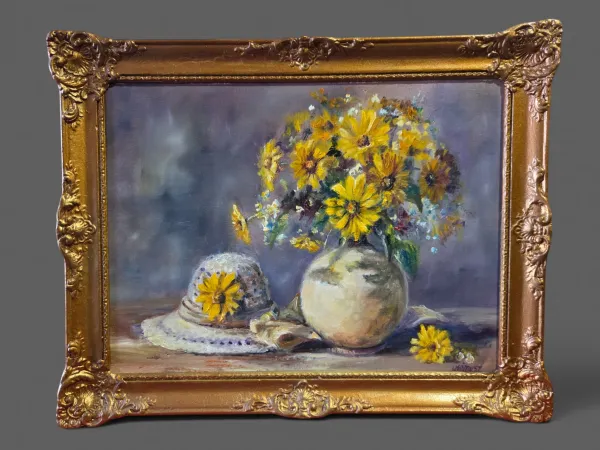
Artist: József Orémusz (b. 1965)Title: Still Life with Yellow Flowers and a Straw HatDate: Contemporary (2010s–2020s)Style: Contemporary Post-Impressionist still life paintingTechnique / Medium: Oil on fibreboard / canvas, in a richly decorated neo-Baroque gilded frameDimensions: 22 × 34 cm (without frame)Signature: Bottom right: Orémusz A contemporary floral still life exuding a sun-drenched, summery atmosphere from the oeuvre of József Orémusz. On the right-hand side of the composition, a lush bouquet of bright yellow wildflowers (sunflower- and daisy-like blooms, with small white and bluish accompanying flowers) shines in a rounded, glazed ceramic vase. To the left of the vase, a a white ladies’ summer hat with a lacy, openwork brim and a seashell rest on the wooden tabletop, whilst in the right-hand foreground a single yellow flower stem and tiny white buds complete the arrangement.The painting’s use of colour is based on an extremely effective complementary contrast: against the cool, veiled violet-blue and pearl-grey tones of the background, the flowers’ warm, cadmium- and sun-yellow petals—applied with impasto brushstrokes—almost glow. The light, dynamic brushwork, combined with the richly patterned, gilded neo-Baroque frame featuring curved lines and shell and floral ornamentation, lends the work a classical yet fresh appearance.Dimensions including frame: 28 x 40 cm.
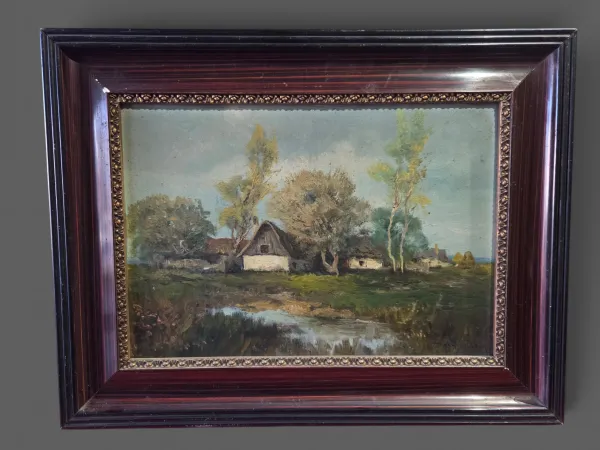
Artist: Sándor HalászTitle: Farmhouse by the Water’s Edge amongst the TreesDate: Mid-20th century (c. 1940–1960)Style: Naturalist landscape painting / atmospheric scene of the Great Plain and Nyírség regionTechnique / Material: Oil on fibreboard, in a dark brown, grained frame with a beaded inner profileA tranquil, idyllic landscape depicting a whitewashed, thatched-roofed country cottage nestled behind the shore of a shallow lake or stream, surrounded by towering leafy trees. In the foreground, against the backdrop of verdant, darker-toned grass and waterside vegetation, a small stretch of water glistens, reflecting the pale blue, slightly overcast sky. In the middle ground, the contrast between the snow-white house wall and the darker gabled roof forms the main focal point of the composition, framed on the left and right by slender poplars and leafy trees, whilst in the distance, haystacks and the outlines of further buildings complete the horizon.Dimensions: 25 × 35 cm (without frame)Signature: Bottom right: Sándor HalászDimensions with frame: 35 × 45 cm.
— End of collection —
Have a question? Write to us!