Fill in the form below to finalise your purchase, and you will receive a confirmation.
Step 1 of 4 — Customer details
Date of creation: around 1900 (turn of the 19th and 20th centuries)
Style: Neoclassicism / Historicism with Art Nouveau influences
Technique / Material: Polychrome patinated metal alloy (hollow cast), with period two-pin copper screw fastenings, on a stepped red breccia marble plinth
Dimensions: Height: 30 cm
Markings: Unmarked
Genuine, original composition dating from around 1900 (turn of the century):
The two-pole / slotted copper nuts (so-called écrou à encoches/ slotted round nuts) in the recessed holes on the marble base represent the textbook fastening technique used by Parisian and Viennese foundries (e.g. Fonderia / Société des Bronzes de Paris, Viennese salon sculpture workshops) in the late 19th and early 20th centuries. Modern replicas use metric hex-head nuts or adhesive, but here both figures and the stepped marble are held in place by original, hand-tightened, period nuts with notches on both sides.
The stone itself is genuine, solid Italian/French red-salmon breccia marble (not synthetic resin or cement cast), and the signs of wear and scratches on the base are natural, bearing witness to more than 100 years of use.
100% verification of the material:
The grated/worn metal surface visible at the end of the threaded shank and on the rim of the nut unequivocally confirms the initial diagnosis: the body of the statue itself is a polychrome patinated zinc alloy (spiater / régule) (whilst the threaded pins are cast from brass and fixed into it, in accordance with the classic French régule d’art technique).
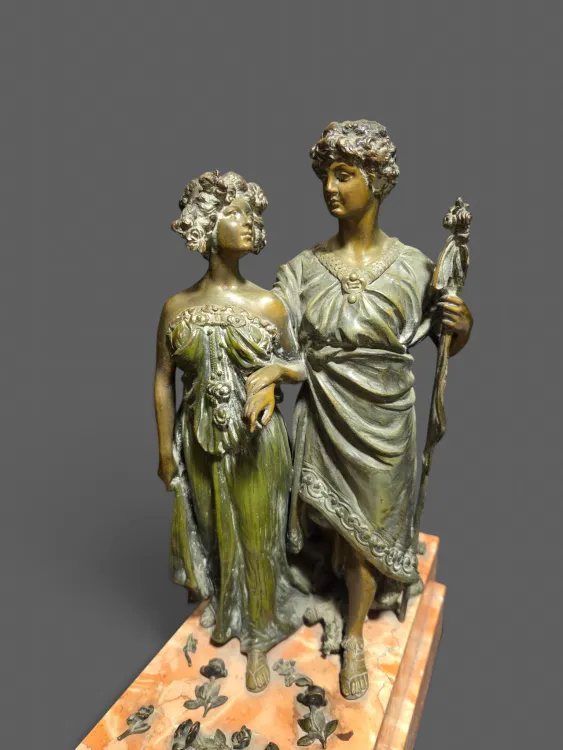
The ancient prototype: the Belvedere Antinous (one of the most famous Roman marble sculptures in the Vatican Museums, a heroic-melancholic depiction of Antinous, Emperor Hadrian’s favourite, which was copied and adapted countless times during the Renaissance and Neoclassical periods). The statue’s head posture, short, curly locks, delicate, slightly downward-cast facial features, and the drape of the strongly evoke the iconographic type of the Belvedere Antinous (and the Belvedere Hermes, with whom he is often associated).
Additional note: The staff held in the statue’s left hand, decorated with ribbons and flowers/garlands, is a thyrsus / shepherd’s crook motif, which reinforces the bucolic-Dionysian atmosphere, whilst the sandal visible on his foot and the shortened, ornately hemmed ancient robe evoke the Roman/Hellenistic world.
The ancient prototype: One of the best-known female types in Roman sculpture is Pudicitia (the personification of modesty/dignity) and the draped Hellenistic nymph/muse types (such as the women of Herculaneum or the ancient figures with richly draped cloaks gathered at the back or flowing down).
The Art Nouveau adaptation: Whilst the ancient Pudicitia closely covers the body, here the artist has combined her with an Art Nouveau–Neoclassical twist: on the upper body, a peplos-like design appears, adorned with delicate garlands and pearl-string motifs whilst revealing the chest and shoulders, whilst the posture of the figure, the antique hairstyle arranged in a bun or curls, and the dress, which falls in a long, train-like drape onto the red marble plinth, evoke the elegance of classical Roman draped sculptures.
The way the two figures face one another, their clasped or touching hands, and the roses scattered across the red marble plinth convey the lyrical atmosphere of the Roman Venus–Mars / Venus–Adonis / Cupid and Psyche, into the bourgeois salon sculpture of the turn of the 19th and 20th centuries (c. 1890–1910).