Fill in the form below to finalise your purchase, and you will receive a confirmation.
Step 1 of 4 — Customer details
Ferenc Újházy (1827–1921) was one of the oldest and most highly respected ‘pioneers’ of 19th-century Hungarian Biedermeier and Realist academic painting. Throughout his life, which spanned almost a century, he witnessed the birth and institutionalisation of modern Hungarian fine art.
A soldier in the War of Independence: He was born in Szolnok. As a young man, he interrupted his studies to fight as a volunteer in the Revolution and War of Independence of 1848–49.
Exile in Vienna and the Dutch Masters: Following the defeat of the War of Independence, he was forced to flee to Vienna. There, in the imperial art galleries, he spent years studying and brilliantly copying the works of the 17th-century Old Dutch Masters (such as David Teniers the Younger). This influence left its mark on his entire body of work.
The art teacher and cultural organiser: Upon his return, in order to secure a steady livelihood, he worked for decades as an art teacher at various schools. He played an important role in the founding of Hungary’s most significant fine art institutions, and by his later years had become a highly respected, warm-hearted figure (a patriarch) in the Budapest art world.
His achievements: He had been exhibiting at the Pest Art Society since as early as 1851, and in 1867 one of his works was even selected for the World’s Fair in Paris. His works are now held by the Hungarian National Gallery.
Ferenc Újházy’s true hallmark was his meticulous, richly detailed, classical brushwork. He produced outstanding works in three main genres:
Fruit and still lifes: He was one of the most acclaimed still-life painters of his time. In his paintings, the textures of melons, bunches of grapes, silver jugs, hams and other foods are rendered with almost tactile, sensual precision.
Genre scenes: He was particularly fond of depicting Hungarian tavern scenes, cellar revelries, and citizens and peasants playing cards or drinking, all spiced with subtle humour.
Romantic landscapes: He often painted stormy landscapes, shepherds returning home, or details of the shores of Lake Balaton.
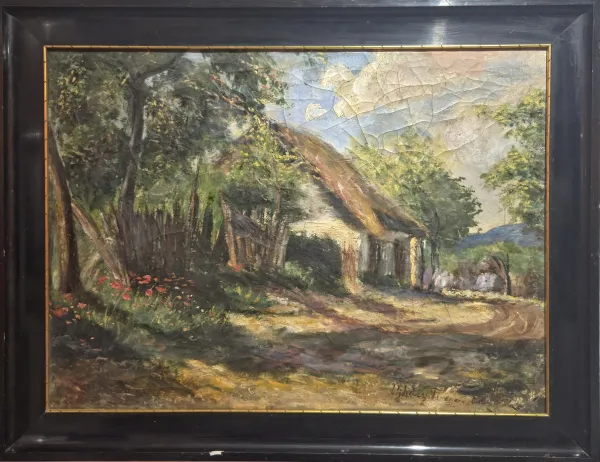
The painting is one of the finest examples of 19th-century Hungarian realist and romantic landscape painting, imbued with an intimate atmosphere. Characteristic of Ferenc Újházy’s mature period, the painting elevates the classic Hungarian rural way of life and the beauty of nature to monumental yet lyrical heights.
At the centre of the composition stands a weathered, white-walled, thatched farmhouse, surrounded by old trees with lush foliage. In the foreground on the left, a ditch bank dotted with wildflowers and poppies stretches alongside a rustic wooden fence, which naturally guides the viewer’s gaze towards the blue-tinged mountain ranges looming in the background. The landscape is completed by the figure of a characteristic Hungarian swing well, captured with sketchy yet delicate brushstrokes.
The artist handles light masterfully: the sun-drenched courtyard and the radiance of the cloudy summer sky suddenly emerge from the dense shade of the trees, lending the picture a dramatic yet soothing rhythm. The dense, period-appropriate network of craquelure against the sky beautifully attests to the painting’s patina and authenticity. The painting is complemented by an elegant, deep black period wooden frame with a gold inner border, which enhances the deep, warm tones of the composition.