Fill in the form below to finalise your purchase, and you will receive a confirmation.
Step 1 of 4 — Customer details
Endre Komáromi-Kacz (9 June 1880 – 16 October 1969) was one of the leading figures in 20th-century Hungarian bourgeois genre and interior painting.
Background and education
Early years: He was born in Komárom. His talent for drawing became apparent at an early age, and he began his studies at the School of Applied Arts in Budapest (now the University of Fine Arts).
Teachers: He studied under such giants as Károly Ferenczy and Gyula Benczúr, but also spent time at the Nagybánya Artists’ Colony and in Munich.
Study trips to Europe: He travelled extensively throughout Italy, Germany, and then spent a considerable time in the Netherlands (in Zandvoort and Amsterdam), where the interplay of light and shadow in the works of the 17th-century Dutch masters (particularly Vermeer and Pieter de Hooch) had a profound influence on him.
Artistic career and organisational work
Awards: From the 1910s and 1920s onwards, he exhibited regularly at the Műcsarnok and the National Salon. His work was recognised with several awards, including those from the Society of Fine Arts.
Artistic life: He was a founder and long-standing president of the National Salon Artists’ Association, and a respected figure in Budapest’s cultural life at the time.
Later years: After the Second World War, he worked more quietly and in seclusion in his studios at Lake Balaton and in Budapest until his death in 1969.
Style and legacy: His chief virtue was his virtuoso depiction of light: he painted with masterful skill the sunlight filtering through windows, the warm atmosphere of middle-class homes, and the gleam of copperware and antique furniture. His paintings remain, to this day, permanent and valuable features of Hungarian auctions and private collections.
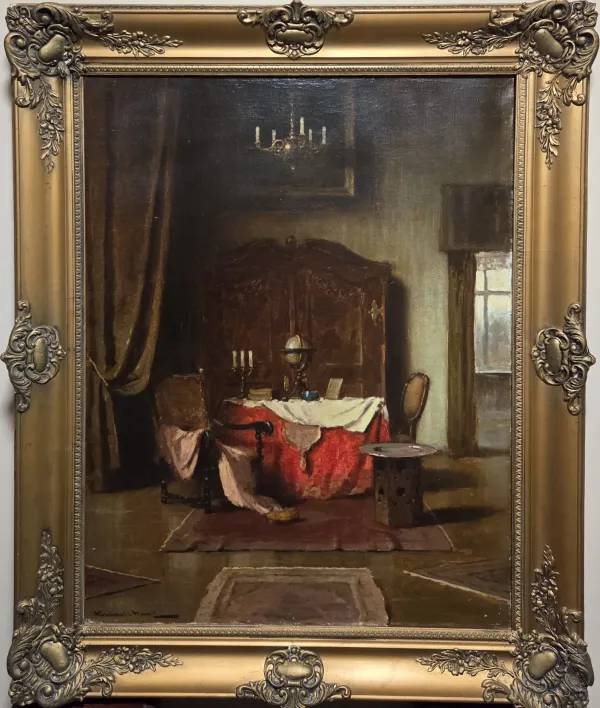
This exceptionally intimate, deeply toned and elegant interior scene revives the spirit of European ‘intimacy’ painting from the late nineteenth and early twentieth centuries, as well as that of the Dutch interior painting tradition. The painting captures a quiet, secluded moment in a middle-class study or drawing room.
Composition and objects: At the focal point of this vertically composed work stands a table laid with a red tablecloth, upon which a globe, a triple candlestick, books and accessories are arranged. Behind the table stands a monumental, carved Baroque or Renaissance cabinet, whilst on the left-hand side, a heavy, draped curtain and an armchair frame the space. Against the wall visible in the background, the silhouettes of a chandelier and a painting are discernible, whilst on the right-hand side, a strip of light filtering through a window or door adds depth to the room’s architecture.
Technique: The artist masterfully handles diffused light and dramatic tonal contrasts. The deep, dark brown, burnt umber and tobacco tones of the room are broken up by the vibrant, burgundy-red colour of the tablecloth and the cream-white fabric draped over it, creating a sharp, elegant focal point. The coppery, golden reflections on the candlestick and the globe exude a subtle, bourgeois luxury.
This distinctly intellectual composition, exuding classic elegance and tranquillity, is a premium collector’s item amongst interior scenes and depictions of bourgeois settings; it creates a dignified, warm focal point in a study, library or bourgeois salon.