Fill in the form below to finalise your purchase, and you will receive a confirmation.
Step 1 of 4 — Customer details
István Ilosvai Varga (1895–1978) was one of the most prominent and influential figures in 20th-century modern Hungarian painting, and a leading master at the Szentendre Artists’ Colony.
Education: He studied at the College of Fine Arts in Budapest (under Károly Ferenczy), then travelled to Paris in the 1920s, where he absorbed the influences of French modernism and post-impressionism.
The Szentendre period: He settled in Szentendre in 1935. The town’s narrow streets, old houses, doorways and the banks of the Danube became the enduring subjects of his paintings.
Style: His painting is characterised by a unique blend of constructive expressionism and lyrical realism. His paintings are characterised by thickly applied, brilliant, pure colours (particularly deep blues, warm browns, ochres and reds), black outlines and slightly blocky yet extremely powerful forms.
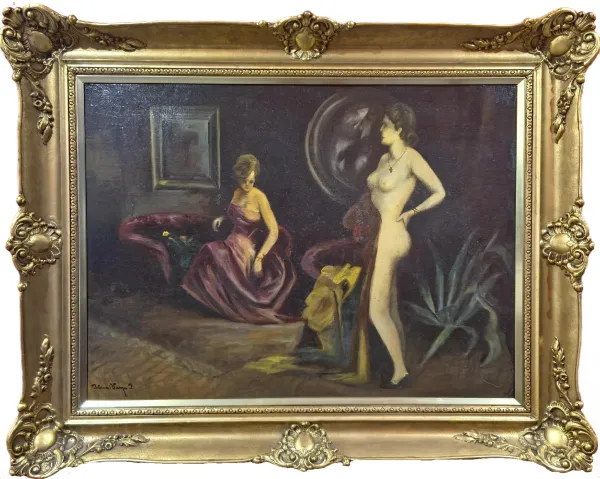
István Ilosvai Varga: Studio Scene (Nude Woman with Drapery in an Interior)
Technique: Oil on canvas
Dimensions: 60 × 80 cm
Signature: Ilosvai Varga I. (bottom left)
Description: The painting is a truly exceptional work, imbued with an intimate atmosphere, representing 20th-century Hungarian modernism and the painting traditions of Szentendre. The composition depicts a classic bourgeois interior or studio setting, featuring two female figures: a lady seated on the sofa in an elegant, mauve-coloured evening gown, and, in contrast to her, a graceful, standing nude who is just casting aside her drapery.
In a manner characteristic of István Ilosvai Varga, the atmosphere of the painting is defined by deep, velvety tones. Against the dark, brownish-purple background, the warm skin tone of the standing female figure—sculpturally rendered—shines out almost dramatically, framed by a circular mirror or ornament in the background. The artist works with delicate textures; the curves of the furniture, the wall hanging on the left and the exotic houseplant (agave) positioned at the far right create a perfect balance between the geometric and the organic. The scene exudes a subtle melancholy, as well as the refined sensuality characteristic of the Parisian and Szentendre schools of the turn of the century.