Fill in the form below to finalise your purchase, and you will receive a confirmation.
Step 1 of 4 — Customer details
Kálmán Döbröczöni (Kórós, 25 July 1899 – Miskolc, 23 October 1966) was a Hungarian painter and graphic artist whose work was closely intertwined with the artistic life of Miskolc and the northern Hungarian region, as well as with the painting traditions of Nagybánya.
Childhood and early years: He was born in Kórós, a small village in the Ormánság region, into a family of modest means. His father worked as a village blacksmith and also farmed the land. After finishing primary school – at the age of thirteen – he became a carpenter’s apprentice in Sellye.
Artistic studies: It was whilst working as a carpenter’s apprentice in Budapest that he began to take drawing and his studies more seriously. At the College of Fine Arts, he was a student of Ágost Benkhard, and later worked as the master’s teaching assistant. In addition, he spent time at the Miskolc Artists’ Colony, where he gained valuable experience in plein air (outdoor) painting.
Foreign scholarship: In 1933–1934, he was awarded the prestigious Collegium Hungaricum scholarship in Rome, enabling him to work in Italy for an extended period. His time in Italy (particularly the landscapes of Naples and Capri) left a profound mark on his art.
Teaching and organisational activities: He was a leading figure in Miskolc’s cultural life. In 1945, he organised a Free School of Art in Miskolc. Between 1950 and 1961, he also worked as a life drawing teacher at the College of Applied Arts in Budapest.
Connections to Szentendre: From 1956 – following an invitation from friends – until his death, he remained a member of the Szentendre Artists’ Colony and was a regular visitor to the artists’ town on the banks of the Danube.
Style: His painting was influenced by the Nagybánya school of painting, realism and decorative naturalism.
Main themes: He particularly enjoyed painting landscapes (including the Danube Bend and Italian coastlines), portraits and still lifes, and was deeply concerned with the fate of the people of the Ormánság region and the lives of ordinary folk.
Oeuvre: He was an exceptionally prolific artist; his estate comprises more than 900 oil paintings, though many of his works have been lost or are in private hands. His works can often be seen at auctions and temporary exhibitions in Hungarian galleries.
He passed away in Miskolc in October 1966, shortly after the death of his wife. His memory is preserved through museum exhibitions and collection displays (for example, at the Miskolc Gallery).
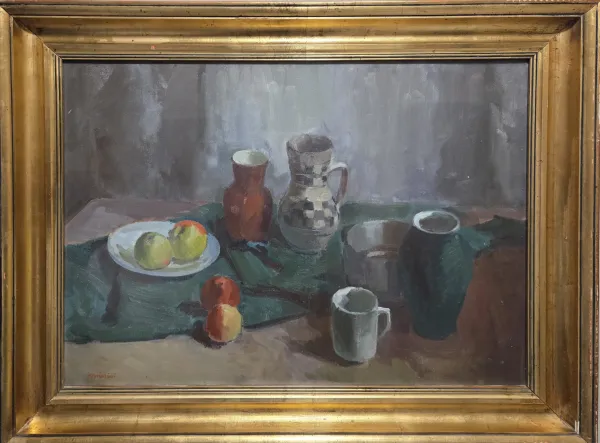
In Kálmán Döbröczöni’s oeuvre, still lifes – although perhaps less frequently discussed than his landscapes or portraits, which strive for monumentality – occupy an extremely important place. In his body of work, the still life is not merely a static arrangement of objects, but a kind of intimate inner world in which the painter’s relationship with forms, materials and light is revealed. We often encounter intimate interior details in his works, such as breakfast tables, flowers (for example, spring cherry blossoms) or simply the everyday objects of daily life.
Kálmán Döbröczöni’s still lifes (focusing on objective reality and painterly quality)
True to his Nagybánya roots, Döbröczöni’s still lifes are characterised by a solid structure and a realistic approach to space.He does not lose the objects in abstraction; the elements of the still life (be it a fish laid out on a kitchen table, crockery or fruit) possess a tangible reality. The arrangement of the objects is natural, never overly ornate or sterile: they give the impression that the picture has been frozen for a moment in time.
The artist’s brushwork in these paintings is rich, lush and vigorous. He does not work with meticulous, hyper-realistic detail, but emphasises the paint itself and its texture.
His handling of light and shadow (chiaroscuro) is masterful: light often falls on the table from the side, glinting off the glazed surfaces of the crockery or the silvery scales of the fish, whilst the background sinks into a deeper, more tonal twilight.
Kieselbach Gallery and Auction House
His colour palette is dominated by earth tones (browns, ochres, greys), occasionally punctuated by a brighter splash of colour (such as the colour of a piece of fabric or a vegetable), thus creating a quiet yet vibrant harmony.
Behind Döbröczöni’s still lifes lies the austere, puritanical spirit of the Great Plain and the Ormánság region, as well as a respect for the world of peasantry and craftsmanship. A still life featuring fish or a simple breakfast table is not merely a compositional challenge for him, but a celebration of the sanctity of everyday life. A human presence can be sensed behind the objects: who was sitting at that table? Who prepared the food? This quiet humanity runs through his still lifes as well.