Fill in the form below to finalise your purchase, and you will receive a confirmation.
Step 1 of 4 — Customer details
Yevgeny Viktorovich Vuchetich (Евгений Викторович Вучетич, Yekaterinoslav, 28 December 1908 – Moscow, 12 April 1974) was one of the most significant and internationally renowned figures in 20th-century Russian and Soviet sculpture. He began his art studies at the Rostov School of Art, then studied at the Leningrad Institute of Painting, Sculpture and Architecture Institute (formerly the Imperial Academy of Arts) between 1931 and 1933.
His work is characterised by heroic realism and an extraordinary ability to shape space. He is credited with a series of the 20th century’s best-known public monuments: the Soviet Soldier of Liberation (1946–1949) in Treptow Park, Berlin; the monumental complex at Mamayev Kurgan in Volgograd, featuring the 85-metre-tall Motherland Calls (1959–1967), and From Swords to Ploughshares (1957), erected in front of the United Nations Headquarters in New York, for which he won the Grand Prix at the 1958 Brussels World’s Fair. His works are included in the permanent collections of the State Tretyakov Gallery in Moscow, the Russian Museum and numerous international public collections.
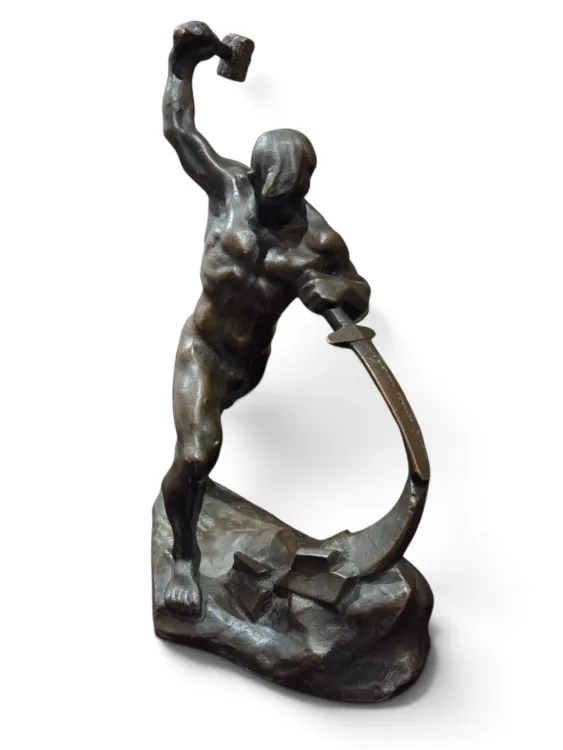
From Swords to Ploughshares (Перекуём мечи на орала) – Leningrad gift copy (1967)
Date of creation: 1967 (based on the 1957 model)
Style: Socialist Realism / monumental sculpture
Technique / Material: Patinated bronze, hollow cast
Dimensions: 25 × 19 cm
Markings: A dedication and signature cast in Cyrillic letters on the side of the plinth: “Dedicated to my dear contemporary. E. Vučetić.”; stamped “MADE IN USSR” on the rim; the inscription “Пусть всегда будет” on the blade of the sword; and a contemporary hand-engraved inscription: “To Endre, as a token of deep respect for our time studying together in Leningrad. December 1967. Boris. Com. 192”
A contemporary, small-scale version from 1967. The composition, embodying the idea from the biblical Book of Isaiah (“They shall beat their swords into ploughshares…”) depicts a muscular male figure who, with a powerful, dynamic gesture, raises his hammer high to transform the sword held in his other hand into a peaceful farming implement, a ploughshare.
The sculpture embodies the classical formal language of Soviet monumental sculpture: the anatomical detail, the sculptural rendering of taut muscles and the dramatic momentum built upon a diagonal axis create a monumental effect even as a small tabletop bronze. The work derives its special historical and collectable value from the quotation from the hymn to peace engraved on the blade of the sword (‘Пусть всегда будет’ – ‘May there always be...’), as well as the personal dedication from Leningrad in December 1967, inscribed on the plinth, which serves as an authentic historical document of the friendship between a Hungarian student (‘Endre’) studying in the Soviet Union and his hall of residence mate (‘Boris’).