Fill in the form below to finalise your purchase, and you will receive a confirmation.
Step 1 of 4 — Customer details
Sándor Turmayer (1879–1953) was a renowned painter of the first half of the 20th century who remained faithful to the Hungarian realist tradition. His life was closely linked to the most significant domestic art centres of his time.
He began his art training at the College of Fine Arts in Budapest, where he laid the foundations for his solid draughtsmanship and classical technical skills. He then moved to Kecskemét, one of the most important centres of Hungarian painting. There, he followed the guidance and intellectual direction of the brilliant realist master, Imre Révész, which proved to be a turning point in terms of his style. Under Révész’s influence, he committed himself to the authentic depiction of folk life, peasant culture and everyday human moments.
Like many of his contemporaries, Turmayer undertook an extended study trip to Italy, where he was inspired by the Mediterranean light, the coastal towns and the historic vedute (cityscapes).
Upon his return, he discovered his main subject in Budapest: he fell in love with the old Tabán district, which has since been demolished. He immortalised its romantic, winding streets, its small houses with crumbling walls and its hidden courtyards in countless lyrical paintings built upon a delicate interplay of light and shadow, thereby leaving an important historical record for posterity.
His style was characterised by restrained, subtle naturalism and late Impressionism. His paintings were never dominated by garish colours, but rather by warm browns, ochres, deep greens and soft, almost caressing light.
He exhibited regularly at the Műcsarnok and the National Salon, and was a popular artist amongst collectors, regarded as a reliable source of quality work. He remained faithful to the values of classical painting until the end of his life, keeping his distance from radical avant-garde movements. His works remain frequent and popular features at domestic auctions to this day.
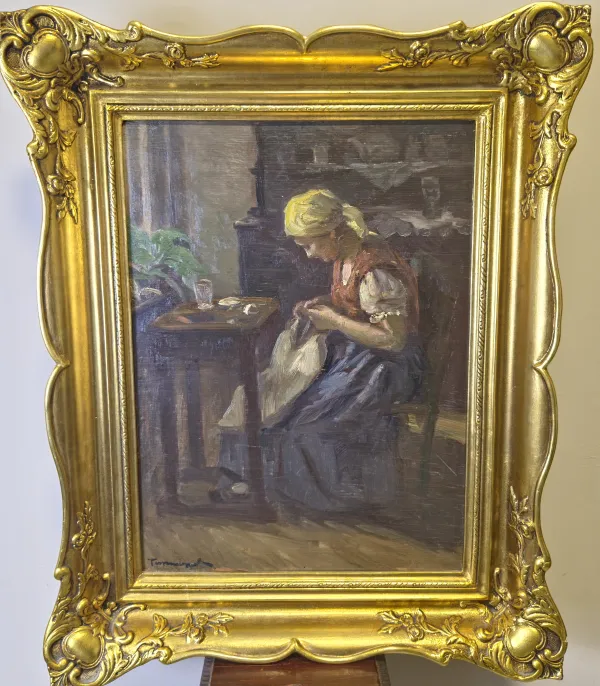
The work shown in the photograph is an authentic genre painting (scene from everyday life) from the first half of the 20th century, imbued with an exceptionally intimate atmosphere. At the centre of the work sits a young girl dressed in traditional Hungarian folk costume (a white blouse with puffed sleeves, a burgundy/red waistcoat, a dark skirt and an apron), who is deeply concentrated on the needlework in her hands – either sewing or embroidery.
In this work, Sándor Turmayer revives the finest traditions of the old Dutch minor masters and the Hungarian realist school (Mihály Munkácsy, Imre Révész). The true power of the painting lies in its masterful use of light and shadow (chiaroscuro): the natural light filtering in from an unseen window on the left beautifully illuminates the girl’s face, her blonde hair and the white fabric, whilst the room’s rustic, heavy wooden furniture, the sideboard in the background and the houseplant are all shrouded in soft half-light. The scene exudes the quiet, meditative and peaceful atmosphere of bourgeois and rural life in that era.