Fill in the form below to finalise your purchase, and you will receive a confirmation.
Step 1 of 4 — Customer details
Rezső Bálint (1885–1945) was one of the most fascinating figures in 20th-century modern Hungarian painting. His art and career were profoundly influenced by the Nagybánya artists’ colony, where, alongside traditional naturalist painting, he was also exposed to the latest modern artistic movements.
He was one of the most exciting figures among the Nagybánya Neo-Impressionists and the early Hungarian avant-garde.
What is worth knowing about his career?
The Nagybánya years: he worked at the Nagybánya artists’ colony between 1904 and 1909. He was there at precisely the time when the young artists (the ‘Neos’) rebelled against the traditional style of Károly Ferenczy and introduced the pure, bold colour palette of the Fauves from Paris. Rezső Bálint also joined this modern, innovative group.
The influence of Paris: He visited Paris on several occasions, where he fully absorbed the influence of French modernism. He befriended renowned artists of the time living there (such as Amedeo Modigliani).
Style: His paintings blend the Nagybánya landscape tradition with elements of Cubism and Fauvism. His forms are often geometric and clean-lined, with strong contours and vivid, decorative colours – as can be seen in the painting above, which depicts a street in Nagybánya.
After the war: He was a member of the progressive artists’ group KÚT (New Society of Fine Artists). Sadly, the horrors of the Second World War did not spare him either: he became a victim of the Holocaust in 1945.
His works are now held by such renowned institutions as the Hungarian National Gallery, but they also regularly appear at auctions held by the country’s leading auction houses (e.g. Kieselbach, Virág Judit).
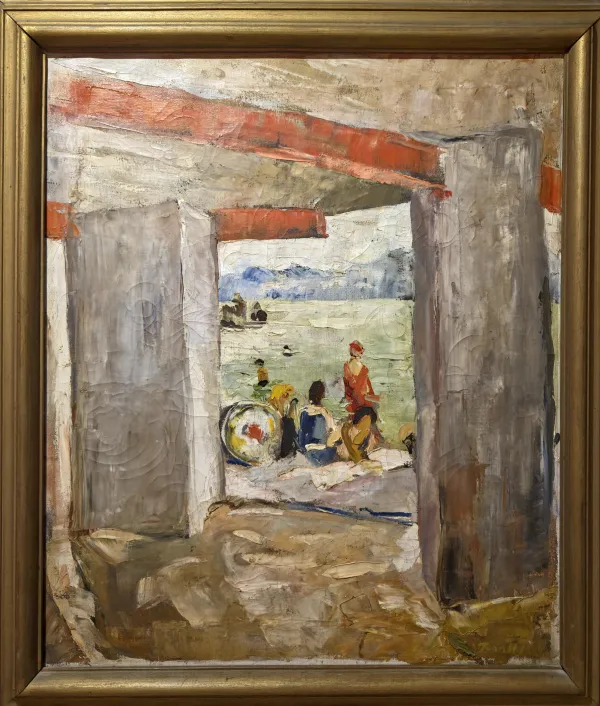
Rezső Bálint (1885–1945): Bathers (View of the Water’s Edge)
Medium: Oil on canvas
Style: Early Hungarian Modernism / Post-Impressionism
Location: Southern France / The Mediterranean coast (Côte d’Azur, Nice) Rezső
Bálint spent a long period in France during the 1920s.
The composition of the painting – the view opening out from a foreground featuring columns, arcades or stone vaults onto the rocky shore, the blue-green waters of the Mediterranean and the figures on the seashore – is a typical Mediterranean veduta. It is highly likely that the painting was created in Nice or in one of the small coastal towns on the Riviera (e.g. Menton or Villefranche-sur-Mer), where Rezső Bálint regularly painted en plein air. Date of Creation: Between 1925 and 1929
Style: The painting’s thick, expressive brushwork, based on composition, and its distinctive figurative rendering are characteristic of the artist’s mature period in France.
Parallels: The transition between the exhibited *Lóri under the Walnut Tree* (c. 1920) and the *Parisian Interior*: by the mid-1920s, he had reached a level where structure and the vibrant Mediterranean light converged in this way.
Description of the work: The painting is a work from the mature period of Rezső Bálint, an artist with an exceptionally unique vision, drawing on the traditions of the Hungarian avant-garde and the Nagybánya school. The painting reinterprets one of the most popular and sought-after motifs of 20th-century modern Hungarian painting – the light-hearted, sun-drenched summer beach scene – but with a decidedly bold and innovative compositional approach.
The artist places the viewer in a darker, shadowy foreground, framed by architectural elements – thick, geometric pillars and striking, reddish crossbeams. Through this distinct, almost Cubist frame, we look out onto the bustling waterfront bathed in sunlight. This interplay of interior and exterior spaces (the contrast between the dark interior and the radiant exterior) lends the scene a profound sense of depth and an intimate, voyeuristic quality.
In the background, against a watery surface in delicate shades of turquoise and green, (red, blue and yellow) are relaxing on the sand beneath a large, patterned beach parasol, whilst in the distance the silhouettes of the blue-tinged mountains fade gently into the horizon. Rezső Bálint’s brushwork is extremely expressive and textured: he applied the paint thickly and sculpturally to the canvas, whilst the dense surface texture and period-appropriate craquelure (net-like cracking) beautifully highlight the work’s authentic, historical value. The classic gilded frame that frames the painting elegantly counterbalances the work’s modern spirit. The painting can be dated to between 1925 and 1929.