Fill in the form below to finalise your purchase, and you will receive a confirmation.
Step 1 of 4 — Customer details
Menyhért Tóth (1904–1980) was one of the most extraordinary geniuses of 20th-century Hungarian fine art, who charted a highly individual course. Although he was posthumously awarded the Kossuth Prize, during his lifetime he was regarded as almost a complete outsider, creating his work in solitude in the countryside, far removed from the mainstream art scene in Budapest.
He is often referred to as the ‘hermit of Hungarian fine art’ or the ‘white painter’.
A difficult start: He came from a poor peasant family (he was born in Mizse). For many years, he earned a living through manual labour (as a labourer and farmhand) in order to save money for his studies. He finally graduated from the College of Fine Arts in his thirties.
Kecskemét and solitude: He spent most of his life in Kecskemét and the surrounding farmsteads. He did not belong to any fashionable artistic group.
The ‘white period’ (his style): In his early years he painted colourful, expressive pictures, but he found his true, world-class artistic language in the last two decades of his life. His paintings are characterised by thick, almost relief-like layers of monochrome white, off-white and grey paint, from which human figures, animals and myths.
Worldview: His art is deeply spiritual and cosmic, exploring the connection between peasant life, the earth and the universe.
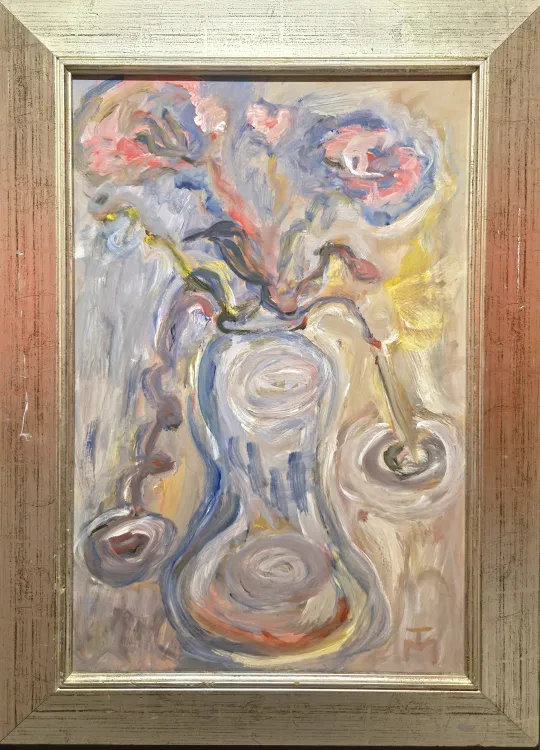
The painting is the work of Menyhért Tóth, one of the most authentic and distinctive artists of 20th-century contemporary Hungarian art. The painting is a perfect example of the artist’s period when he elevated everyday, simple subjects – such as a vase of flowers – to spiritual and lyrical dimensions.
At the centre of the composition stands a robust yet gently curved vase, from which the flowers burst forth in an organic, almost swirling motion. Menyhért Tóth did not seek to depict the petals with botanical precision, but rather to capture the plants’ vital energy and inner pulsation. The brushwork is extremely dynamic, impasto-like and expressive: the densely applied layers of paint create a sculptural, textured surface on the canvas.
The colour scheme is dominated by the veiled, whitish-pastel tones that are the artist’s trademark (ashy greys, soft blues and pinks), which are counterbalanced by the ochre and brilliant golden-yellow lights shimmering in the background. This subtle play of light lends the still life an intimate, meditative atmosphere. The distinctive ‘TM’ monogram visible in the lower right-hand corner and the modern, silver-and-gold-toned frame surrounding the painting stylishly frame this collector’s piece of high artistic quality.
Signed, bottom right: TM.