Fill in the form below to finalise your purchase, and you will receive a confirmation.
Step 1 of 4 — Customer details
Bertalan Vigh (1890–1946) was a renowned Hungarian painter and a popular portraitist and figure painter of the first half of the 20th century.
He was born on 5 April 1890 in Rimaszombat. He studied at the School of Applied Arts and the College of Fine Arts, where he was taught by such renowned masters of the era as Károly Ferenczy, Ede Balló and László Hegedűs. He first exhibited his works in 1912.
Following the outbreak of the First World War, he was conscripted and, upon the fall of Przemysl Castle, was taken prisoner by the Russians. He was transported to Turkestan, in the vicinity of Samarkand, where he continued to create art throughout his years in captivity. He gained considerable renown and built a successful career whilst in captivity through his portraits of members of the local Russian community and his scenes of Central Asian life. It was during his time there that he met his wife, Mária Karotkova, who was born in Samarkand; they married in Budapest in 1922, after his return home.
Upon his return to Hungary, he quickly gained recognition, primarily for his female portraits and figurative compositions, characterised by a fresh, colourful elegance.
He is a favourite painter amongst collectors.
His main stylistic features include a light, expressive brushstroke, pure colours and a sensitive capture of the subjects’ individuality.
Wikipedia
His best-known works include *Triumphant Eve*, *Pearls*, and his portraits of the actress Dita Parlo and his wife.
Wikipedia
Bertalan Vigh died in Budapest on 1 September 1946, aged 56.
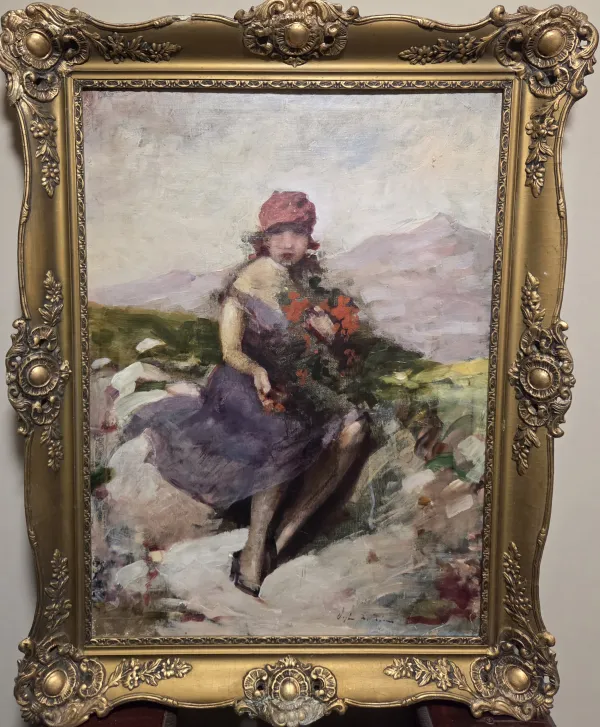
This exceptionally light, elegant and airy genre portrait evokes the world of early 20th-century plein air Impressionism and salon painting. The painting captures a charming, outdoor moment featuring a young, elegant lady.
Figure depiction and composition: At the centre of this vertically oriented work is a female figure seated on a rock or slope, dressed in a fashionable lilac gown and wearing a carmine-red hat. The lady holds a lush, splayed bouquet of red flowers in her lap, whilst her gaze turns gently towards the viewer. The pinkish, mist-shrouded mountain ranges looming in the background and the open sky lend the composition a sense of spaciousness and height.
Technique and colour scheme: The artist builds up the image with a virtuoso, light and dynamic brushstroke. The folds of the dress, the hat and the rocky surfaces in the foreground are composed of vigorous, decisive impasto patches. The palette is dominated by warm accents of lilac, terracotta and carmine red, which are set against the soft, powder-pink, dusty grey and olive-green tones of the background to create an elegant symphony of light.
This highly decorative work, with its cheerful and nostalgic aura, is a premium piece for lovers of bourgeois genres and Impressionist depictions of women; it creates a refined, cheerful focal point in an elegant drawing room, boudoir or bourgeois interior.