Fill in the form below to finalise your purchase, and you will receive a confirmation.
Step 1 of 4 — Customer details
An artistic family and early years: He was born in Bordeaux on 15 May 1827. His father, Raymond Bonheur, was an art teacher and landscape painter who encouraged his children – including Isidore, Rosa and Juliette – to take an interest in the arts from an early age.
Education: He began his career as a painter as a pupil of his father and sister, and in 1849 he was admitted to the École des Beaux-Arts in Paris.
Transition to sculpture: Although he made his debut at the Paris Salon (Salon de Paris) in 1848 with a painting, he soon turned to sculpture and bronze casting, where his true talent came to the fore.
Awards and career: He was a regular exhibitor at the Salon, where he won medals in both 1865 and 1869. He was awarded a gold medal at the 1889 Paris World’s Fair, and was subsequently awarded the French Legion of Honour (Légion d’honneur).
Family and studio collaboration: Most of his bronze sculptures were cast and published by his brother-in-law, Hippolyte Peyrol, at his foundry. His works were highly regarded by both the Parisian and London art markets. Isidore died in Paris on 10 November 1901.
Childhood and family background: She was born in Bordeaux on 16 March 1822. Her father, Raymond Bonheur, was a landscape painter who recognised his daughter’s talent at an early age and taught her to draw. Her family – including her younger brother, Isidore-Jules Bonheur – were deeply committed to the arts.
Her studies and love of nature: As women were not permitted to receive formal academic training at that time, she studied in her father’s studio and copied the works of the classical masters at the Louvre. She began studying live animals at an extremely young age: she travelled the countryside to anatomical dissection theatres and livestock markets in order to gain a perfect understanding of the animals’ anatomy and movement.
Artistic breakthrough and successes:
In 1841, he made his debut at the Paris Salon.
In 1849, he enjoyed enormous success with his painting *Ploughing in the Nivernais* (*Labourage nivernais*), which was purchased by the French state (it is now on display at the Musée d’Orsay).
In 1853, he completed his magnum opus, the monumental canvas *The Horse Market* (*Le Marché aux chevaux*), which brought him worldwide fame and eventually found its way to the Metropolitan Museum of Art in New York.
International recognition: Her works were highly acclaimed in both Great Britain and the United States; Queen Victoria herself admired her paintings. She was the first woman to be awarded the Cross of the Legion of Honour in 1865 (the honour was presented to her by Empress Eugénie).
An independent lifestyle: She was famous for her independent, unconventional way of life. She received official permission from the authorities to wear men’s clothing (permis de travestissement), which was practical for her when attending fairs and carrying out work with animals. She spent much of her life at her château near Fontainebleau (Château de By), where she maintained her own private zoo (with lions, deer and horses).
Her death and legacy: She died on 25 May 1899 in Thomery. Her body of work not only ranks her amongst the greatest of the Realists and animal painters, but also made her a symbol of women’s equality and artistic independence.
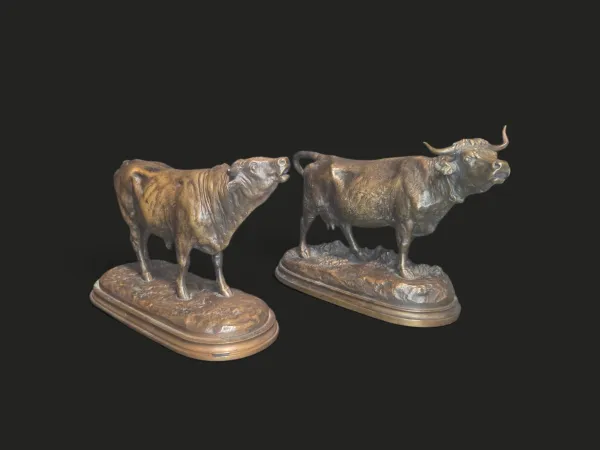
The bronze sculptures shown in the photographs are the work of members of the famous French Bonheur family of artists, specifically the animal sculptures by Isidore-Jules Bonheur (1827–1901), an animal sculptor (animalier), whose work is celebrated in close association with that of his famous sister, Rosa Bonheur (1822–1899), a painter and sculptor.
Isidore-Jules Bonheur was one of the most renowned masters of 19th-century French animal sculpture (École Animalière). Together with his sister, Rosa Bonheur, they formed one of the defining artistic families of the era.
The signature visible on the plinth of the sculptures reads: ‘I. BONHEUR’ ‘Peyrol’ foundry mark.
The Peyrol foundry (Fonderie Peyrol) was one of the most renowned and prestigious bronze foundries in 19th-century Paris, having become famous for the precise craftsmanship of its masterpieces in French animal sculpture (École Animalière).
The statue of the bull.
Composition and tone: The bull is depicted in a standing, proud posture, with its head raised slightly, as if sniffing the air or gazing at the horizon. The figure is powerful and robust, expressing the animal’s ferocity and physical strength.
Anatomical accuracy: The sculptor modelled the musculature, the prominent contours of the shoulders, the indentation beneath the ribs, and the thick folds of the neck with remarkable precision. Isidore does not idealise the animal, but depicts it true to life, in the natural setting of the 19th-century French countryside.
Surface treatment (patina): The surface of the bronze is richly textured; the warm brown patina beautifully plays with light and shadow, highlighting the fine details of the skin and fur.The connection between the Bonheur family and the Peyrol foundry.
The Cow sculpture.
Composition and character: The depiction of the cow captures a calmer, more natural movement. Its head is turned slightly to the side and upwards, whilst its udder and body structure are precisely modelled.
Naturalism: The sculpture’s surface clearly reveals the bone structure (the protrusion of the hip bones), the taut skin and the fine texture of the fur. The earthen plinth, dotted with tufts of grass, further emphasises the closeness to the countryside and nature.
Casting and signature: The ‘I. BONHEUR’ signature attests to the authenticity of the casting and bears the masterful mark of Isidore Bonheur. The craftsmanship of the plinth bears witness to the high-quality French bronze casting techniques characteristic of the period.
Family ties: The founder of the workshop, François Hippolyte Peyrol (1832–1903), married Juliette Bonheur (1830–1891), who was the sister of Rosa and Isidore-Jules Bonheur.
Exclusive and close collaboration: As a master foundryman, Hippolyte Peyrol became the almost exclusive bronze caster and publisher (éditeur) of the Bonheur siblings’ sculptures – particularly those of Isidore Bonheur and Rosa Bonheur.
A factor adding value on the art market: On the art market, bronzes by Isidore Bonheur or Rosa Bonheur bearing the original Peyrol foundry mark are significantly more valuable. The presence of the mark confirms that the sculpture is an early, first-class cast produced during the artist’s lifetime (or immediately following that period).